Eþelþryþ Who?
The Enigmatic Old English Dry-point Runes in the St Petersburg Insular Gospels
DOI:
https://doi.org/10.33063/futhark.14.1088Keywords:
Old English runica manuscripta, futhorc, dry-point runes, bind-runes, Saint Æthelthryth, Bede, colophon, scribal signature, scribal commentAbstract
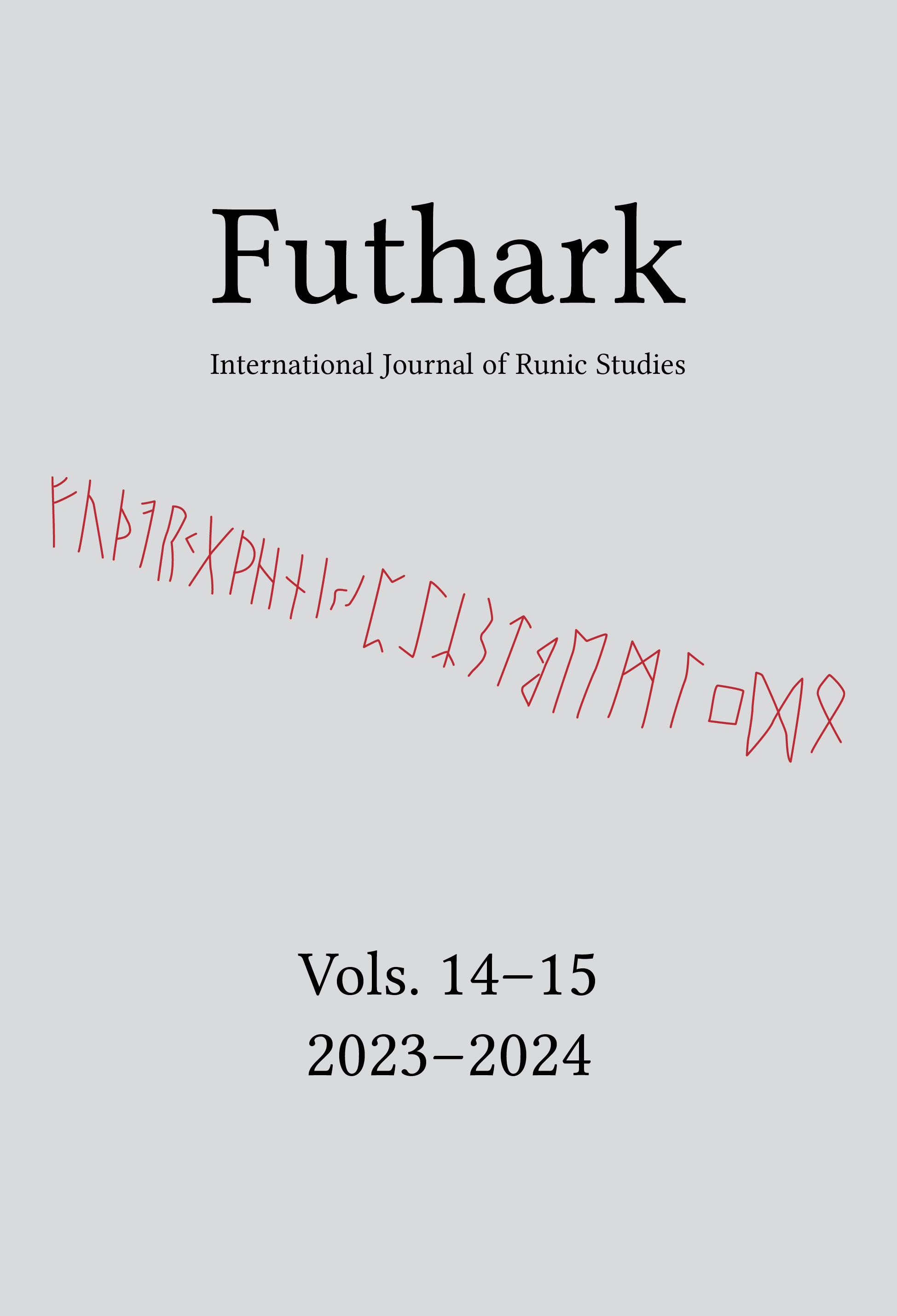
This article offers the first extensive discussion and a new interpretation of the dry-point sequence incised in Old English runes on fol. 213r of St Petersburg, National Library of Russia, MS Lat. F.v.I.8, commonly known as the St Petersburg Insular Gospels. The dry-point runes most likely spell the Old English female name Eþelþryþ. However, the central character of the sequence, which is unparalleled in the Old English runic corpus, offers multiple possibilities for interpretation. By placing the dry-point runes into the immediate context of the manuscript page as well as into broader historical and runological perspectives, this article argues that the dry-point inscription employs visual play and functions either as a corrector’s signature or as an encrypted commentary on the surrounding Latin Gospel of St John, prompting readers to remember and meditate on the virtues of Saint Æthelthryth, the seventh-century abbess of Ely.
Published
Issue
Section
License
Copyright (c) 2025 Beth Newman Ooi, Kerstin Majewski, Lilla Kopár

This work is licensed under a Creative Commons Attribution 4.0 International License.